

Flock's Nationwide Safety Audit 100 Days Later
A hundred days ago, Flock's CEO said his company was kicking off a "nationwide safety audit for all our poles," and that he would "share more on this soon." Neither the company nor any highway authority has shared any progress.
After videos about Flock’s dangerous poles went viral, Flock announced it would be kicking off an audit for its equipment’s compliance with road safety standards. On day one, Flock said it had replaced sixteen poles in Tennessee. A hundred days later, and we have heard nothing from Flock, state regulators, cities, counties, or police departments, about the progress of the audit of the remaining 120,000 or so installations.
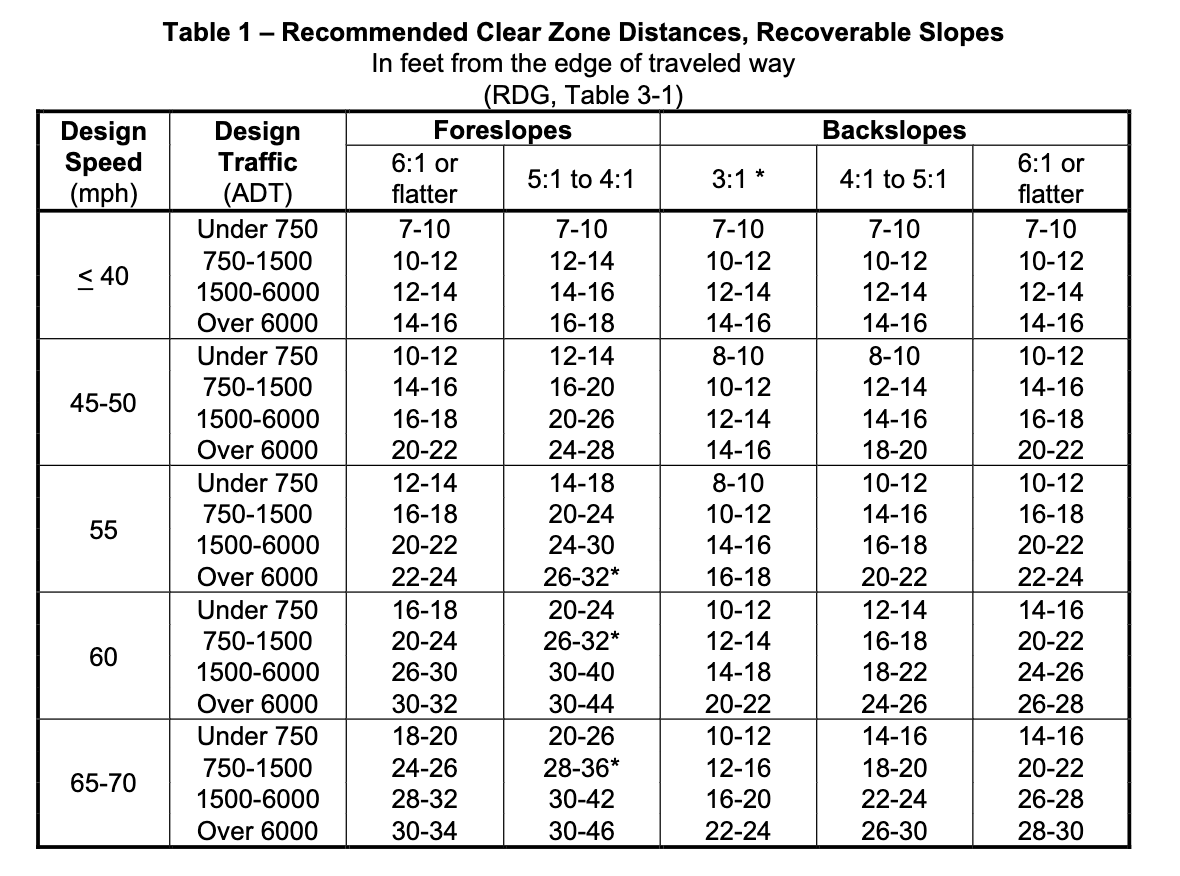
The roadside safety issue in a nutshell: safety regulations and standards generally require objects to be placed a certain distance from the roadway, for somewhat obvious reasons. In situations where an object needs to be closer to the road (e.g. a sign for an exit), standards require it to be “breakaway” — if a vehicle hits it, the equipment has to yield safely.
The regulations are complex, but what it comes down to for the most part is that equipment within a certain distance of the road needs to (1) have a good reason to be there; and (2) be on a breakaway footing or a breakaway pole.
AASHTO Clear Zone distances table (via Iowa DOT)
#The Guardrail Guy and the Audit
In 2016, Steve Eimers lost his seventeen-year-old daughter Hannah in a car crash involving a faulty guardrail. Steve became a prominent advocate for road safety, and over the years has called out many problems with equipment to regulators. He also calls out the issues more publicly on his YouTube and TikTok, where he is “The Guardrail Guy.” He posted several videos about issues with Flock cameras, including where they were installed in the “clear zone” and without proper breakaway supports.
Steve is hard to dismiss as an anti-surveillance advocate, because he isn’t one. On July 14, he posted a video on YouTube titled “Flock Camera in the guardail [sic] runout area.” At the time of writing, that video has 2.3 million views. Eimers met with Garrett Langley “and several other senior officials” on July 22. Flock announced it would be doing an audit that same day. Eimers told Wired he drove by a shot-up Flock camera on July 25 and decided to stop posting about them. He has since resumed.
Flock announced it had fixed sixteen poles in Tennessee, and the rest would follow. Langley, in a video attached to the press release announcing the audit, says that Flock has “[s]ite images from all of our deployments” and that the company does “human verification” on all installations. He also calls the audit “measures above and beyond what often departments of transportation require.”
That process did not catch the camera in Fremont County, IA, where the permit called for a standalone installation but the camera was attached to an existing structure. It also doesn’t appear to cover the many installations where permits don’t exist, or where the county doesn’t even know about the cameras.
#A Letter About a Different Pole
But more importantly, Flock is talking about exceeding standards where it does not meet them to begin with.
Its whole proposal already fails at step 1: a good reason to be in the clear zone. Flock has none, other than wanting to collect data to sell to police. But even if you were to consider private mass surveillance as a legitimate use of a public right-of-way, it would still fail at step 2: safety.
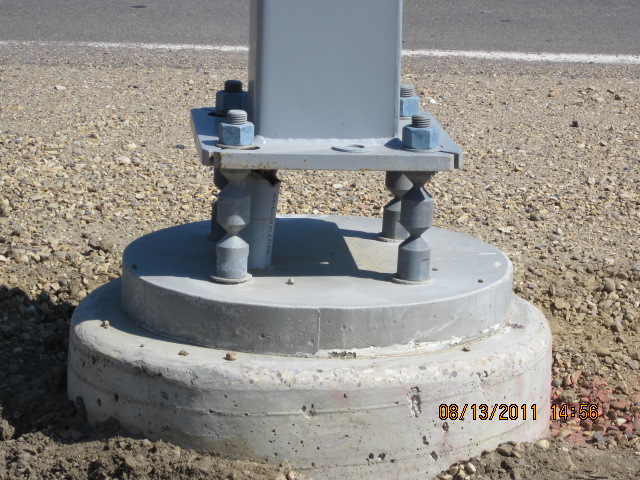
For some of its clear zone deployments Flock does use breakaway slip bases. For others, it uses a metal pole sunk into concrete. Of course, metal poles can be breakaway poles, and Flock claims its poles are. There’s just nothing to back that up.
What Flock appears to rely on for its “breakaway” claim is a letter about a different pole. In 2007, the FHWA sent that letter to a Georgia-based company called “Addresses of Distinction, LLC.”
That company makes decorative mailboxes and address signs. Addresses of Distinction asked the FHWA to accept their aluminum tubes as a breakaway sign support by showing that its tubes (2.875" and 2.375") have below-ground “anti-rotation hardware” and that a similar tube was crash-tested by the state of Florida. FHWA issued the letter.
No problem so far, but there are a few points to note:
- The specific Addresses of Distinction, LLC, tubes were never themselves crash-tested. FHWA relied on a comparison based on specifications.
- In weak soil, the baseline test shows “posts pulled out of the ground partially or completely, allowing the vehicle to gradually come to a stop”
- In strong soil, tests were conducted on posts fitted with anti-rotation hardware below ground; with that extra hardware, the poles fractured on impact.
- The letter covers “aluminum tube sign supports.”
- This is a NCHRP 350 letter. FHWA stopped issuing NCHRP 350 eligibility letters after January 1, 2011, in favor of MASH testing. Under the FHWA/AASHTO agreement, new sign supports on National Highway System contracts let after December 31, 2019 have to be MASH-tested.
The letter notes that “[a]ny changes that may adversely influence the crashworthiness of the device will require a new acceptance letter.” There are some:
- Flock grouts the pole into a concrete caisson. The tested posts were buried in soil, where they either pulled out or, with anti-rotation hardware below ground, fractured. Nobody tested what happens when the pole is encased in concrete.
- Flock uses a two-piece pole, not the single tube that was approved.
- Flock put 30lbs of surveillance hardware on it, rather than a sign.
- Flock attaches flammable Li-ion batteries.
The changes are all shown in the diagram Flock submitted in the permit application along with the letter. It shows up in a February 2023 application to Riverside County, CA, for eight cameras in Murrieta, titled “Pole Details.” It is the only pole safety document in the set. Four of the eight camera coordinates on sheet 3 are in Tracy, CA, 400 miles away. The plans are marked “approved by” the Flock employee applying for the permit.
Despite those glaring defects, Riverside County rubber-stamped the application.
#Permits Without Inspections
In the permit packet, Flock’s diagram is labeled “INITIAL DRAWING,” and dated October 26, 2020. Ten months after FHWA and AASHTO’s deadline for MASH on new sign supports. State and local regulators, like Riverside County, appear unbothered and continue to approve permits based on the diagram-letter pairing. Of course, they have also approved permits with MS Paint site plans before.
Before it banned LPRs earlier this fall, FDOT kept a public list of approved LPR supports. Flock’s only entry with an approval letter was a 4" aluminum pole on a “Frey transformer base,” used for the Pinellas County Sheriff’s Office.
This wasn’t much better. The “letter” is a March 2024 email chain. FDOT’s reviewing engineer asked Flock for structural calculations. Flock’s permitting manager sent a “MASH cert” instead, and noted that “this MASH cert only applies to the Frey Poles.” FDOT’s state maintenance engineer then waived the calculations because the pole “matches” FDOT’s standard for a Rectangular Rapid Flashing Beacon (Index 654-001).
The Frey pole referred to is a crosswalk pushbutton pedestal (Frey Manufacturing catalog CP6, shown on sheet SPEC.02 of the Pinellas plans). Its FHWA letters, SS-183 and SS-184, are MASH TL-3 tests of a 4-foot and a 15-foot pipe with a pedestrian push button. Here too, the letters cover the device “as tested” and say “[m]odifications made to the device are not covered by this letter.” A Flock camera is not a “push to cross” button.
For the 2.875" pole, Flock’s most recent FDOT drawing (July 2025) describes a “Flock MASH Coupler Pole” built around a “Proveli Breakaway Style 7 Coupler,” part number “SP-7/MASH.” There is no FHWA letter for Proveli or that coupler.
One issue is that states lack standards because legislatures never approved roadside surveillance hardware. Iowa, for example, has nothing to allow mass surveillance equipment to be placed on the side of the road. It does have rules for mobile speed camera trailers,[1] with setbacks and crashworthy barriers. For fixed cameras, despite Flock clearly not being a utility,[2] Iowa DOT has approved permits under its utility accommodation program.
That program requires an “as-built” plan with a licensed engineer’s stamp, and allows the DOT to inspect at the permittee’s expense if none is submitted. Iowa DOT, however, has taken the circular position that it treats the permitted plan as the as-built unless the permittee reports a deviation by submitting an as-built plan. The process appears to be similarly effective in states other than Iowa.
States don’t specifically track crashes involving surveillance hardware, and don’t appear to act on complaints from the public about safety issues.
#“Will Share More on This Soon”
In its press release for the pole audit, Flock says “Meeting existing standards is important, but Flock believes the industry should continue looking for ways to improve beyond minimum requirements.”
Three months later, there is still no FHWA hardware eligibility letter for Flock or any Flock pole. The only safety evaluation letter it uses doesn’t describe its actual hardware and has to come from FHWA’s archives, not its live database.
In nearly a decade of the company installing 120,000+ devices, there is no indication its standard pole has ever complied with any safety standard, let alone a higher one it set for itself. Langley said he would “share more on this soon.” Nothing, not even statements by Flock, show that any meaningful work has happened, beyond, perhaps, the 16 poles in Tennessee Flock claims to have replaced.
#Who Is Actually Checking
Two weeks ago, Fox 9 in Minnesota reported safety issues with Flock poles, after a retired firefighter found Flock poles that “do not match permit and installation specs.” Fox 9 also reports that Woodbury, MN, not Flock, is “conducting a review of all ALPR installations to verify they comply with all applicable state and local regulations and permitting requirements.”
It is a defect Flock could have easily caught by comparing the site images it claims it collects to the permit, either immediately after installation or during the audit. But it didn’t. Of course, Woodbury and MNDOT didn’t catch it either. Not during an “as-built” inspection, and not during any regular inspections.
And that’s troubling, because it shouldn’t be Flock doing this audit at all. It also shouldn’t fall on people who have lost family members, like Steve Eimers or Exit261. Road safety lands squarely within the purview of the state and local governments who set the standards, approve the permits, and inspect the work.[3]
It is another example of Flock getting caught breaking laws and rules, and where its only response is to say it deployed “guardrails” of its own invention.
As long as no state DOT or county road department steps up to do its job, Flock will keep investigating itself and reporting nothing. It will also keep encasing ornamental sign posts in concrete, and dropping 30lbs of glass panels and flammable batteries on impaled drivers.
In the name of public safety.
Happy Halloween.
P.S.: Let me know if you have information on crashes. And if you get hurt, be sure to send a copy of this post and Langley’s video statement to your personal injury lawyer.
Trailers are its own problem, as a video by Exit261 shows. Exit261’s daughter Jaida was killed by a faulty guardrail FDOT allowed to exist. ↩︎
“The term “utility” shall include all privately, publicly, municipally or cooperatively owned systems for supplying water, sewer, electric lights, street lights and traffic lights, gas, power, telegraph, telephone, transit, pipeline, heating plants, railroads and bridges, or the like service to the public or any part thereof if such system be authorized by law to use the streets or highways for the location of its facilities.” — Iowa Code § 306A.13 ↩︎
Or, rather, those are things state and local governments are supposed to be doing. ↩︎