
In thirteen years of operation, the Iowa Public Information Board has built a legacy comprising a single $1,000 fine and one declaratory order. It has not prosecuted a complaint since 2017. In 2025, it dismissed more than 90% of complaints without a meaningful investigation.
The Iowa Legislature created IPIB in 2012 to give Iowans “an efficient, informal, and cost-effective process for resolving disputes” about open records and open meetings laws — without resorting to litigation. Nine governor-appointed members were meant to mediate and, where necessary, adjudicate complaints about governments withholding public records or holding secret meetings. For this purpose, the board was authorized to act as a prosecutor on the public’s behalf.
That is not what the board does, or what it has ever done. IPIB keeps complaints away from courts — not to adjudicate them, but as a black hole that attracts complaints and prevents them ever escaping to meaningful review. The board should be dismantled and Chapter 23 repealed.
#The Legislature’s Double-Tap
It is immediately evident from the chart above[1] that since 2018 the number of cases IPIB has received has remained more or less stable, but if you have attended any of the board’s meetings, you probably heard complaints about increasing workloads.
The workload statement is true to an extent, but the increased workload does not stem from complaints. In part, it stems from a law enacted in July, 2025 (HF 706), which “created a requirement that all newly elected and appointed officials of a government body attend training on Iowa’s Sunshine laws”.
Iowa has 99 counties and close to 1,000 incorporated cities, in addition to myriad state and other agencies. That’s a lot of “elected and appointed officials” who will require training.
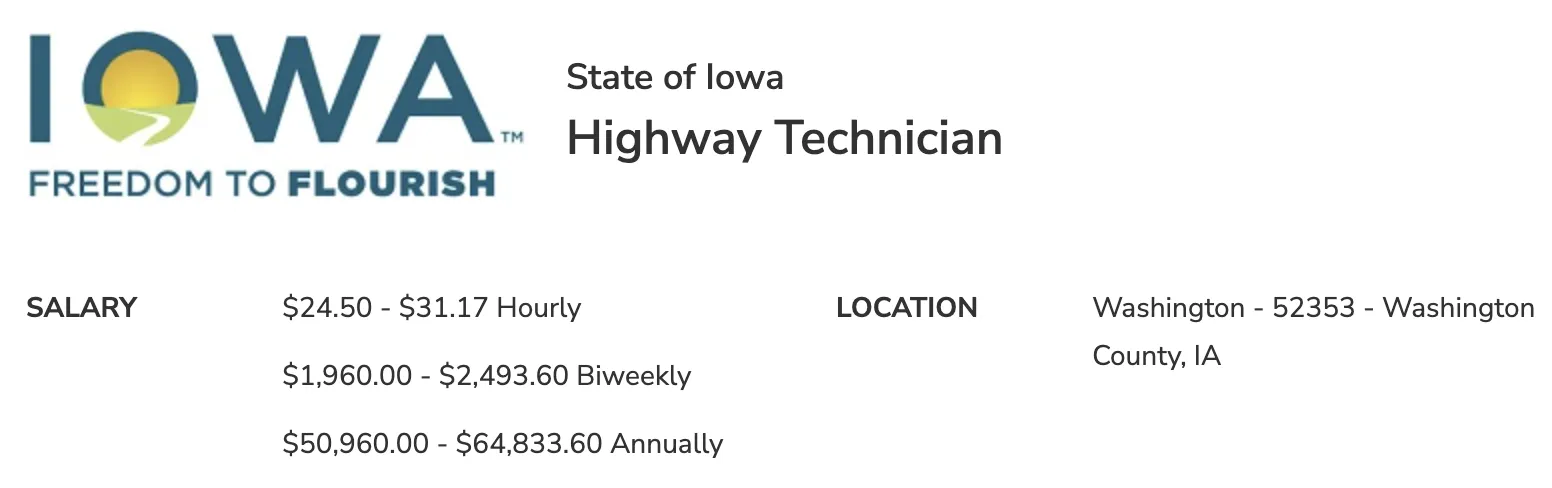
IPIB is not required to actually deliver the trainings to officials, but it is required to ensure that one approved course is available at no cost. Unfortunately for everyone involved, IPIB pays its staff attorneys in Des Moines the same rate Iowa DOT pays its Highway Technicians (a position that requires a GED and a CDL permit rather than a JD) in rural Washington County.
When any third party would need to charge more, IPIB staff providing the trainings is the only fiscally responsible choice.
IPIB’s (hourly) Administrative Assistant 2 retired in 2024, taking home $68,494.34 that year.
In a February 2025 budget presentation, then-director Eckley listed “Turnover” as a “challenge,” noting that “Only 1 out of 3 staff has tenure over 1 year.”
That presentation was published in between the board getting sued for violating open meetings law when Eckley gave herself a 6% raise, and before Eckley resigned and the board offered her replacement, Charlotte Miller, the pre-raise salary.
In this context, it would be hard to fault IPIB’s attorney for considering “Lunch and Learn” sessions as more of a networking opportunity than a job responsibility.
By passing HF 706 the legislature ensured IPIB remains ineffective, even if it ever decided to change course. It redirected citizen complaint resolution time to government official training. The board teaches a law it has no time to enforce.
IPIB’s budget has not meaningfully changed between 2018 and 2025, but for FY2026 it estimates a sudden $91,259 (24%) increase, with most of that increase allocated “for hiring of contractor to implement mandatory training per approp language and/or to help with backlog”, confirming that training and complaint-handling time are competing for the same funds.
According to the figures presented at the February board meeting, that backlog is growing fast: between November 2025 and January 2026, 95 cases were opened while only 55 cases were closed. The figures only reflect those two states: “opened” and “closed.” The director omitting case disposition in the presentation to the board suggests her focus is purely quantitative, not qualitative.
At that same meeting, staff said, “we’re no longer drowning as much … we’re treading water” and suggested potential efficiency improvements by pointing out “we’re doing all our own copy editing.” Institutional pressure to reduce backlogs may explain why quality of the work-product isn’t a priority, but professional responsibility still attaches to the individual licensed attorneys drafting deficient orders.
With IPIB’s entire budget swallowed by its personnel costs only to leave them treading water, there is neither time nor money for IPIB to actually do its job of prosecuting violations.
If the board gives its staff nothing to do but take the government on Lunch & Learn dates, can we really expect fair outcomes? The answer is in the chart above: the number of complaints that are actually investigated and handled is low. Very low.
#Complaints and Procedural Smokescreens
The process IPIB must follow is outlined in Iowa Code Chapter 23. It is relatively straightforward and probably what you would expect from a process like this.
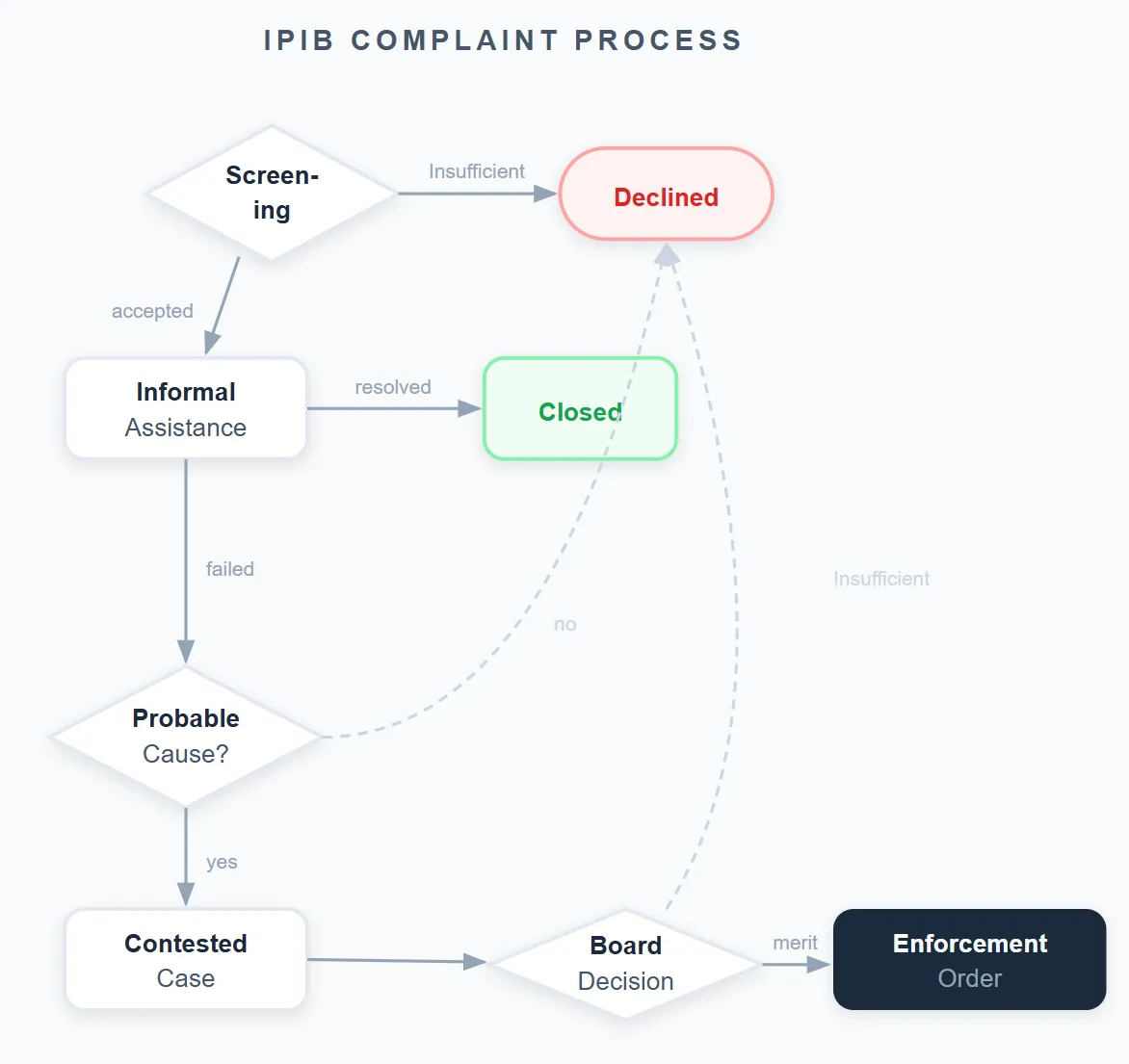
The screening stage is intended to act as a filter for obviously deficient complaints. IPIB’s inbox may be filled with complaints from people caring loudly about issues well outside its purview. Initial screening is a necessary escape-hatch to allow staff to recommend directly discarding such complaints.
After that initial review, “informal assistance” should be IPIB’s bread and butter. The board’s raison d’être is to be an informal alternative to slow, costly litigation. Informal resolution is step one after the initial review.[2]
After informal assistance, if the complaint is not resolved, staff investigate the complaint to determine if there is probable cause to believe a violation has occurred. During this process, IPIB can issue and enforce subpoenas to obtain necessary evidence; it can also hear witnesses.
This isn’t a full investigation, but an investigation of probable cause. If a complainant says a document was not produced, this would be the step in the process where IPIB might obtain a copy of an email from the city showing that the record was produced.
Finally, if probable cause is found, the case proceeds to a contested case, and IPIB is to engage in fact-finding and analysis of law. A contested case requires gathering evidence, hearing witnesses, and analyzing legal frameworks.
All of that is what the law requires. The diagram below illustrates what actually happens.
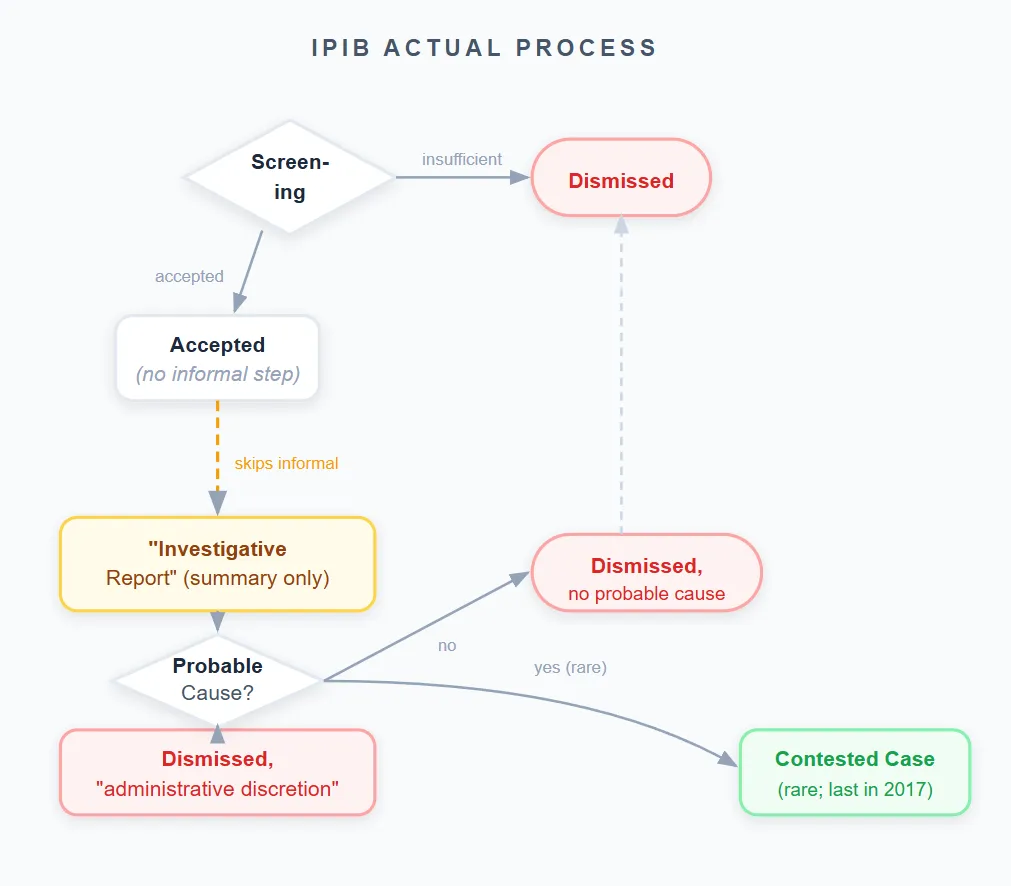
IPIB changed its primary process in November 2024. The new process is described in its 2024 annual report as a “new process [that] better aligns with the requirements outlined in Iowa Code chapter 23.” In other words, the process it used before was “less aligned”, or, in regular English: non-compliant.
That non-compliance was the basis for two separate district courts reversing IPIB complaints a day apart — November 29, 2024, was a remand in van Pelt v. IPIB, and Swarm v. IPIB remanded on November 30, 2024. In both cases, the district court agreed the dismissal was improper, reversed IPIB’s dismissal, and remanded the complaint to IPIB for processing.
In Swarm, IPIB accepted the complaint and almost immediately dismissed it again — this time, “as an exercise of administrative discretion.” Swarm petitioned for review of the new dismissal order and the case is currently pending in Henry County. For van Pelt, IPIB appealed and lost at the Iowa Court of Appeals. It has not yet accepted the complaint.
In 2023, before IPIB’s “more aligned” process, it dismissed 69% of complaints at initial screening. In 2025, after the “alignment,” that number became 47%, but 42% were dismissed for lack of probable cause immediately after screening, but still before investigation, and 2% were dismissed for administrative discretion.
Even without additional context the numbers would be a red flag—the board is telling the public that 90% of their complaints are unfounded or not even worth looking at.
Reviewing a small sampling of “insufficient” complaints confirms that they were not being reviewed for sufficiency at all.
Take, for example, 23FC:0026. Here, the complainant “alleged that she requested a copy of a 911 call concerning the report of a deceased body. She alleged that the CCSO denied the request.” This alone already constitutes a valid complaint: a record was requested, it was withheld. Was it lawfully withheld? Maybe, maybe not. That requires an investigation.
However, rather than investigate, IPIB immediately dismisses the complaint for lack of sufficiency because “it is difficult to see a public interest that is met by releasing the 911 phone call under what would be a traumatic situation for all individuals involved.”
Following its determination of trauma, IPIB then decides that the “value of confidentiality” is greater than the public interest. IPIB does not specify what that value is, or what public interests it outweighs. It applied a balancing test to a factual record consisting of a single sentence about the incident: “the 911 call involves an incident in which the caller found a dead body”.[3]
IPIB never looked at whether the complaint was legally sufficient on its face. It instead applied the Iowa Supreme Court’s Hawk Eye balancing test,[4] which weighs confidentiality interests against public interest in disclosure. Like most balancing tests, it can only be applied when a developed factual record is available. IPIB applied it at screening, to a single, unverified sentence.
In late 2024 and throughout 2025, after the introduction of the “more aligned” process, these types of dismissals are partly supplanted by “dismissed, no probable cause.” This sounds like an improvement, but on closer inspection it becomes clear that it is a procedural smokescreen and a mislabeling of what actually occurs.
Take, for example, complaint 25FC:0046. This complaint survived initial screening and was accepted by the board. The next step is informal assistance, but no informal assistance was given, and no informal resolution was ever proposed or rejected.
IPIB proceeded anyway. Rather than examine “books, papers, records, electronic records and other real evidence”, or talk to any witnesses, IPIB simply summarized the original complaint and the school district’s response and slapped an “investigative report” label on it. It closed its eyes and saw no probable cause.
The new “more aligned” process fails to see that the most significant alignment issue was never procedural labeling, but a complete lack of informal assistance — the reason for IPIB’s existence. Neither the old “dismiss for insufficiency” process, nor the new “dismiss for lack of probable cause” process includes that critical step.
Finally, 25FC:0042 illustrates what happens when a board takes discretion beyond what the law provides. It is a clearcut case where a college (ICCC) admits that “its Board agendas were posted online without a physical posting”. That violates Iowa’s open meetings law. However, because “ICCC has unilaterally taken measures to ensure all future agendas are physically posted”, IPIB still dismissed the complaint “as an exercise in administrative discretion”.[5]
Iowa Code Chapter 23 does not provide for administrative discretion. It authorizes IPIB to dismiss a complaint for lack of jurisdiction, find no probable cause after investigation, or proceed to a contested case upon finding probable cause. Dismissing an already-admitted violation appears nowhere in the statute. IPIB relies on its Rule 497-2.2(4)©, which it was never authorized to write.[6]
What Chapter 23 does provide for is informal assistance, which would have consisted of IPIB discussing the proposed—and already implemented—resolution with the complainant. It might have tried to convince the complainant that there wasn’t much more that could be gained from the complaint. Instead, IPIB decided it was done and dismissed the case.
Rather than provide informal assistance, which is the reason the board exists, an increasing majority of IPIB’s decisions fall within those three categories of dismissal.
#IPIB at the Court of Appeals
In its appellate brief in van Pelt v. IPIB, the board rejected its job out loud:
Van Pelt wistfully opines that IPIB’s failure to conduct a formal investigation of his complaint rendered unavailable discovery methods that would have otherwise been accessible to him had he directly filed an enforcement petition in the district court against WDM under Iowa Code section 22.10. Yet, “Iowa Code section 23.5 offers a choice to persons seeking to enforce the open records law.”Van Pelt voluntarily chose to file a complaint with IPIB against WDM in lieu of directly pursuing judicial enforcement of his records request in the district court.By electing this particular remedy, van Pelt subjected himself and his complaint to the framework IPIB implemented through its administrative rules to review and adjudicate public records complaints.
IPIB shamelessly used the word “wistfully” to describe a valid legal argument about its flawed case-handling resulting in a loss of statutory rights. That word choice tells you everything about how the board views the people it was created to serve: not as parties with enforceable rights, but as nuisances who should have known better.
That same contempt surfaced when IPIB asked the District Court to stay its order:
. . . any perceived delay in processing van Pelt’s complaint would not constitute a violation of any applicable statutory or administrative requirement as neither Iowa Code chapter 23 nor IPIB’s administrative rules place any deadlines upon the Board’s complaint intake and investigative functions.
In so many words: “even if you make us look at the complaint, we’ll take as long as we want, and there’s nothing you can do about it.” Never mind that IPIB’s own rules require it to “promptly work with the parties” toward an “expeditious resolution.” Following the rules it wrote does not appear to be IPIB’s strong point.
The van Pelt v. IPIB case began life as IPIB complaint 23FC:0104. The short version[7] is that the complainant — me — had requested a “deployment plan” for a company’s surveillance cameras from the City of West Des Moines. That plan was incorporated by reference into its contract with its vendor. West Des Moines responded “we didn’t download it from the vendor website” and IPIB dismissed the complaint without further investigation.
I filed a case for judicial review, originally as a direct challenge to IPIB’s procedural misstep. The trial attorney chose to go in a different, needlessly complex direction.[8] Nevertheless, the District Court found that IPIB had not done its job and sent the complaint back to IPIB for processing.
IPIB chose to appeal and lost on the grounds that the complaint was legally sufficient. But even with an appellate opinion on the books, the board refuses to entertain even the possibility that its process or its interpretation of law may be flawed.
The Iowa Court of Appeals opinion explained that when a government body’s contract expressly incorporates a document, that document “belongs to” the government body under Iowa Code § 22.1(3)(a) — even if the body never retained a physical copy.
The Court also held that the City, as a party to the contract “always has a right to” the entire contract — including what is incorporated into that contract — and that under binding precedent,[9] the City had a duty to produce it from readily available sources.
The opinion then closed two common defenses: first, a claim that a vendor “owns” the document.[10] This defense fails where the government body has contractual approval rights and ongoing obligations. Second, the claim of “I don’t have it.”[11] This defense does not work when an ongoing contractual relationship gives the body ready access.
But perhaps most significantly for future IPIB complaints: the court defined the review standard for IPIB’s initial screening. It describes it as equivalent to a motion-to-dismiss standard where all facts are taken as true and the only question is whether the complaint is legally plausible on its face — meaning “does this complaint allege anything that could be a violation?”
As long as the complaint alleges that a government body withheld a record or did not provide notice for a meeting, the answer is almost always “yes.” IPIB cannot resolve legal or factual disputes at the threshold stage and must investigate complaints that clear that bar.
At least that’s what the court says.
#Business as Usual
In a meeting on March 12, 2026,[12] deciding on whether to seek further review by the Iowa Supreme Court, IPIB’s AG-supplied attorney and its board members brushed the decision off as though it contained nothing of substance, commenting “this is not like we’re going to set precedent — it’s [not] going to change the way we do business.”
To find out what “the way we do business” is, you only have to look at the February 2026 meeting agenda. Nine cases were dismissed via the consent agenda. Some appear appropriate, like dismissals for abandonment or lack of jurisdiction, but others, like 25FC:0184, make determinations of fact and law at initial review (“Because there are no records responsive to the complainant’s request, the Department did not violate Chapter 22 when it closed the request.”)
Most insidiously, one complaint was dismissed via the consent agenda through an order drafted by executive director Miller because “complainant does not argue” a specific enough violation of Chapter 22. The complaint itself wasn’t deficient, but the complainant didn’t do IPIB’s job making its legal argument for it.[13]
At that same February meeting, board member Luke Martz commented to a complainant:
you’re not the first person who’s come to this board frustrated with what we expect our public officials to keep as records that they don’t… you’re not alone.
He then voted to dismiss the complaint for lack of probable cause. IPIB had not held an evidentiary hearing, or engaged in any real fact-finding. It did not subpoena the records to definitively answer whether they exist. The lack of probable cause was wholly based on a passively-voiced “[no] evidence was presented to IPIB that indicated the county was not honest about the existence of the records.”
The remanded van Pelt complaint may be on the agenda for the board’s March 19 meeting; as of March 17, IPIB has not yet confirmed the meeting date or posted the agenda on its website.
#The Board’s Legacy
Of all the complaints IPIB has received since its founding in 2012, it lists only four as contested cases on its website. One resulted in a $1,000 fine, one was settled, one was dismissed, and one was appealed all the way to the Iowa Supreme Court. None of them resulted from complaints dated 2018 or later.
The contested case that reached the Iowa Supreme Court ultimately returned to IPIB’s complaint sink, never to be seen again. In Ripperger v. IPIB,[14] the board found that the Polk County Assessor violated chapter 22. The Supreme Court reversed in part and remanded for IPIB to resolve whether the property owners who requested removal qualified as “persons outside of government” — a factual question the board was specifically instructed to answer. No published order on remand appears to exist. The case entered IPIB’s complaint process and, like the rest, simply stopped.
In addition to handling complaints, IPIB is also authorized to issue “declaratory orders with the force of law determining the applicability of chapter 21 or 22 to specified fact situations”. This allows IPIB to, for example, declare that posting a meeting notice only on a city’s TikTok-account is not sufficient notice, even if nobody has complained about that yet.
IPIB has issued a declaratory order only once, back in 2013. It has, however, produced a number of informal advisory opinions, which are similar to declaratory orders in many ways, but are non-binding informal advice.
In thirteen years, IPIB’s entire record is a single $1,000 fine and one formal opinion. Even worse, IPIB completely neglects the most powerful tool the legislature gave it: the subpoena.[15]
That’s not a result of underfunding, staff training, or resource limitations. That’s an institution that isn’t even trying. Even when IPIB itself determines there is probable cause that a violation occurred, it does not act. Even when a court tells it to handle a complaint, it would rather appeal and spend years in litigation than do its job.
IPIB in its entirety is perfunctory. Its board members and staff would rather “align” procedures in ways that present the appearance of efficiency rather than address the substance of its work—or the lack thereof.
The agency serves only one purpose, and it’s for the state, not the people: to serve as a complaint-sink for Iowans who believe that access to government is a right, not a privilege to be granted at the government’s discretion.
#Connecticut Makes it Work
Connecticut — which has 3.7M residents compared to Iowa’s 3.2M — has had a very similar board since 1975: the Freedom of Information Commission (FOIC). The FOIC has been able to use the same tools IPIB has to mediate two-thirds of its complaints, hold evidentiary hearings, and produce numerous declaratory orders and contested cases each year.
In 2024, the FOIC handled 855 complaints, compared to IPIB’s 134.[16] Those numbers predate IPIB’s 2025 training mandate. That’s important, because Connecticut abolished county governments and currently has only 169 municipal governments — a fraction of Iowa’s.
With similar populations, you might expect more complaints in Iowa. More government bodies could violate the law, and smaller cities and counties might not have dedicated legal staff, or even full-time staff. The exact opposite is true.
Either Connecticut’s agencies are a lot worse at open records compliance than Iowa’s, Iowans have less interest in local government, or — most likely — Nutmeggers have more faith in FOIC than Iowans have in IPIB. For good reason.
FOIC has eight staff attorneys versus IPIB’s two. Each FOIC attorney handled 107 cases, compared to IPIB’s 67, assuming IPIB’s director does not handle complaints. (45 if she does). FOIC’s 2024 orders aren’t a list of procedural and discretionary dismissals either; in fact, contested case hearings are so common in Connecticut that they’re published via weekly agendas. Iowa has not seen one since 2017.
Colleen Murphy joined FOIC in 1990. She became its executive director in 2005. She retired in February of 2026. Connecticut retains staff and builds deep institutional knowledge while IPIB greases the gears of its revolving door.
#IPIB’s Future
IPIB could have been Connecticut. The concept was sound. The incentive structure that has been in place for years has undone the concept and replaced it with an executive bureaucracy wholly divorced from the institution’s original purpose.
For years, IPIB’s budget was flat. The recent bump was accompanied by more work. Its staff turns over faster than it can develop institutional knowledge. Its board members are appointees with no particular accountability to the public it supposedly serves. And the legislature, which created IPIB as a cheap alternative to litigation, has just handed it a training mandate to fully crowd out the complaint work it already wasn’t doing.
IPIB can’t stop and think about what it’s doing while it’s treading water. The legislature has shown the opposite of an appetite for reform. The solution is to dismantle the board entirely and repeal chapter 23.
We could replace it with a new agency, but there is no reason to think it would fare any better. The statute gave IPIB everything it needed. IPIB chose not to use it.
Instead, training functions can be assigned to the Attorney General’s office, where they belong. The AG knows — or should know — open records law well enough to be able to either put together a curriculum, or to approve one to be delivered by a vendor or one of Iowa’s 15 community colleges (at least seven of which have existing legal programs).
Advisory Opinions should not be handled by the AG because of its conflict of interest when defending state agencies. If they are needed, the Office of Ombudsman, which reports to the legislature, could take up the task as it did before IPIB. Alternatively, advisory opinions could be assigned from a lawyer pool, similar to criminal defense appointments.
Adjudication can still happen through the courts. For Iowa Open Records Act (chapter 22) cases, discovery is often unnecessary due to the reversed burden of proof. The Iowa Supreme Court has rule-making authority to create an expedited procedural track for Chapter 21/22 enforcement without new legislation. The small claims process shows that courts have ample leeway in setting expectations for plaintiffs.
IPIB’s declaratory orders — of which only one exists — are covered under the courts’ general declaratory powers.
An informal complaints process is mostly unnecessary. Informal resolution is baked into the general concept of settlement negotiations when a case is reviewed by a court. Governments only settle when it hurts less than the alternative. Taxpayer-funded attorney fees keep that threshold high regardless of forum. Fee-shifting and court-enforced fines for individuals — recently raised to $12,500 for open meetings violations[17] — can provide pressure where IPIB won’t.
But resources spent on mediation would likely be better redirected to free or low-cost legal aid for citizens, and potentially, if it can be kept sufficiently conflict-free, a general “open government helpline” at the Attorney General’s office for both citizens and governments.
Dismantling the board would remove citizens’ temptation to fall into the § 23.5 false election-of-remedies trap. Complainants already need to go to court to get IPIB to investigate. Staying there is the more efficient option.
Swarm v. IPIB illustrates the trap: Swarm’s case stems from an open meetings violation he alleges happened in January 2022. After IPIB dismissed his complaint, Swarm sued the city for the violation, but amended to put IPIB’s name on the suit. When he did, the city joined IPIB. Sixteen months after Swarm filed the case, the district court heard it. It then sat on it for another ten to decide what to do.
It took a full twenty-six months and going toe-to-toe with both the city and IPIB — who filed a combined five attacks on the case before even filing an answer[18] — as a self-represented litigant, but Swarm ultimately prevailed.[19] The complaint was then sent back to IPIB’s “efficient, informal, and cost-effective process for resolving disputes” to finally be looked at. IPIB instead made a near-immediate determination: “probable cause exists to believe a violation has occurred, but, as an exercise of administrative discretion, [we] dismiss the matter.”
Today, more than four years since the alleged violation happened, Swarm is back in court fighting IPIB.[20] He has made no progress whatsoever on the original complaint — Mount Pleasant and IPIB have been spending scarce judicial resources and taxpayer money for years so that one can avoid slapping the other’s wrist.
In January of 2026, Eulando Hayes also filed a lawsuit against IPIB, seemingly because of further improper “probable cause” dismissals in 25FC:0141[21] and 25FC:0142.[22]
When the board is dismantled, Chapter 23 should be repealed in its entirety and any pending complaints should be dismissed without prejudice or triggering the election-of-remedies statute, to be refiled in court.
It’s been more than thirteen years. The board has issued only non-binding advisory opinions, one fine, and one declaratory order. At least two separate litigants have spent years in court in their efforts to get IPIB to look at their complaints — so far unsuccessfully. A third just started.
Even if IPIB survives, the “election of remedies” in § 23.5 must go. Iowans should be able to trust a government agency to do what it says on the tin. But when that fails — when appointees decide doing their job is discretionary — citizens should not be left wistful, longing for a state that believes in the laws it creates.
The charts were created by analyzing the published orders on IPIB’s website. Because the orders do not use a standardized format, a combination of heuristics and AI-analysis was used to detect dispositions. IPIB only began tracking outcomes in 2024. ↩︎
“After accepting a complaint, the board shall promptly work with the parties, through employees of the board, to reach an informal, expeditious resolution of the complaint.” Iowa Code § 23.9 (2026). ↩︎
Its § 22.7(18) analysis is independently questionable. That exemption explicitly excepts from confidentiality information indicating “the date, time, specific location, and immediate facts and circumstances surrounding the occurrence of a crime or other illegal act.” Iowa Code § 22.7(18)©. IPIB simultaneously claimed the 911 call was exempt under § 22.7(5) as part of a peace officer’s criminal investigation — which would make the death precisely the kind of event § 22.7(18)© covers. IPIB never reconciled the tension between those two positions. ↩︎
Hawk Eye v. Jackson, 521 N.W.2d 750, 753 (Iowa 1994) ↩︎
Yes, the order actually says “in”, not “of”. ↩︎
An agency shall have only that discretion delegated to it by law and shall not expand or enlarge its discretion beyond what is delegated. Iowa Code § 17A.23 (2026). ↩︎
There is more to it, but that short version will do for the purpose of this article. ↩︎
IPIB’s dismissal rested exclusively on § 22.1 (“we don’t have the record”); the district court examined § 22.2 (“the vendor performs a government function”). The Court of Appeals opinion turned on § 22.1. ↩︎
Diercks v. Malin, 894 N.W.2d 12 (Iowa Ct. App. 2016) ↩︎
KMEG Television, Inc. v. Iowa State Board of Regents, 440 N.W.2d 382 (Iowa 1989) ↩︎
Clark v. Banks, 515 N.W.2d 5 (Iowa 1994) (per curiam) ↩︎
The meeting was originally scheduled for March 9. IPIB rescheduled to March 12 without updating the date on its website. A timely physical notice posted in Des Moines would satisfy the notice requirement in an obviously unhelpful way IPIB could choose to address. ↩︎
It is readily apparent that the complaint is sufficient, even if the complainant cited the legal basis incorrectly: she requested bodycam footage from the sheriff’s office, the sheriff is subject to chapter 22, bodycam footage is a public record, bodycam footage is not categorically confidential, and the sheriff did not provide the record. That meets and exceeds the legal sufficiency standard. ↩︎
Ripperger v. Iowa Pub. Info. Bd., 967 N.W.2d 540 (Iowa 2021) ↩︎
IPIB confirmed in response to an open records request that it issued no subpoenas between July 2023 and February 2025. Its annual reports and public records reflect no subpoenas in any prior period. ↩︎
IPIB’s annual report shows 134 complaints received (opened cases) in 2024. The chart above, which is based on the number of published orders (closed cases) on the IPIB website, shows 118 complaints in 2024. ↩︎
HF 706, which provided the training mandate, raised the maximum fine for willfully violating open meetings law (chapter 21) from $2,500 to $12,500 but left chapter 22 (open records) violations at $2,500. ↩︎
Two separate motions to dismiss from the City (D0006, D0013), one from IPIB (D0022), a motion to strike from the City (D0010), and a joinder (D0024). ↩︎
Swarm v. City Council of Mt. Pleasant, No. CVEQ006708 (Iowa Dist. Ct. Henry Cnty. Nov. 30, 2024). ↩︎
Swarm v. Iowa Pub. Info. Bd., No. CVEQ007043 (Iowa Dist. Ct. Henry Cnty.) ↩︎
Here, IPIB wrote, “Because the Respondent’s access to . . . records does not amount to ownership of the records, the request and any subsequent complaint should be directed to the proper lawful custodian” — this appears to be facially incorrect if only because Chapter 22 does not contemplate “ownership” per se. Its definition of a public record is “records of or belonging to” the government, which has been read more broadly than mere ownership. ↩︎
“Because the records generated under these policies are akin to confidential job performance evaluations, they fall within the categorical confidential exception under Chapter 22.7(11)(a) and withholding the records at issue does not constitute a violation of Chapter 22” — even though Chapter 22 permits non-disclosure of confidential public records, it does not permit withholding records akin to confidential public records. IPIB did not review the records to establish similarity but simply decided that “the respondent likely generates documents in relation to [its] policies” and that those imaginary records could not possibly fall outside the definition in § 22.7(11)(a). ↩︎